


How to Help Your Anxious Child Simple Strategies for Parents to Reduce Anxiety in Kids
How to Help Your Anxious Child Simple Strategies for Parents to Reduce Anxiety in Kids
discreption
discreption
A Science-Based Guide to Helping Children Feel Calm, Safe, and Confident
Childhood anxiety is more common today than ever before.
Many parents watch their child struggle with constant worries, school fears, stomachaches, bedtime anxiety, or emotional meltdowns — and feel unsure how to help.
This guide was created to change that.
“My Child Is Always Anxious” is a practical, science-based parenting guide that helps parents understand why anxiety happens and how to respond in ways that actually help children feel calmer and more confident.
Instead of complicated psychology or overwhelming advice, this book provides clear explanations, real-life examples, and step-by-step strategies that parents can apply in everyday situations.
Why This Book Is Different
Most parenting advice focuses only on behavior.
This guide explains something deeper:
Childhood anxiety is not a discipline problem.
It is a nervous system response.
When parents understand how the brain and body respond to fear, they can support their child in ways that reduce anxiety instead of accidentally reinforcing it.
This book translates modern psychology and neuroscience into simple tools any parent can use.
What You Will Learn Inside
This guide walks parents through the full picture of childhood anxiety and how to respond effectively.
Inside the book, you will learn how to:
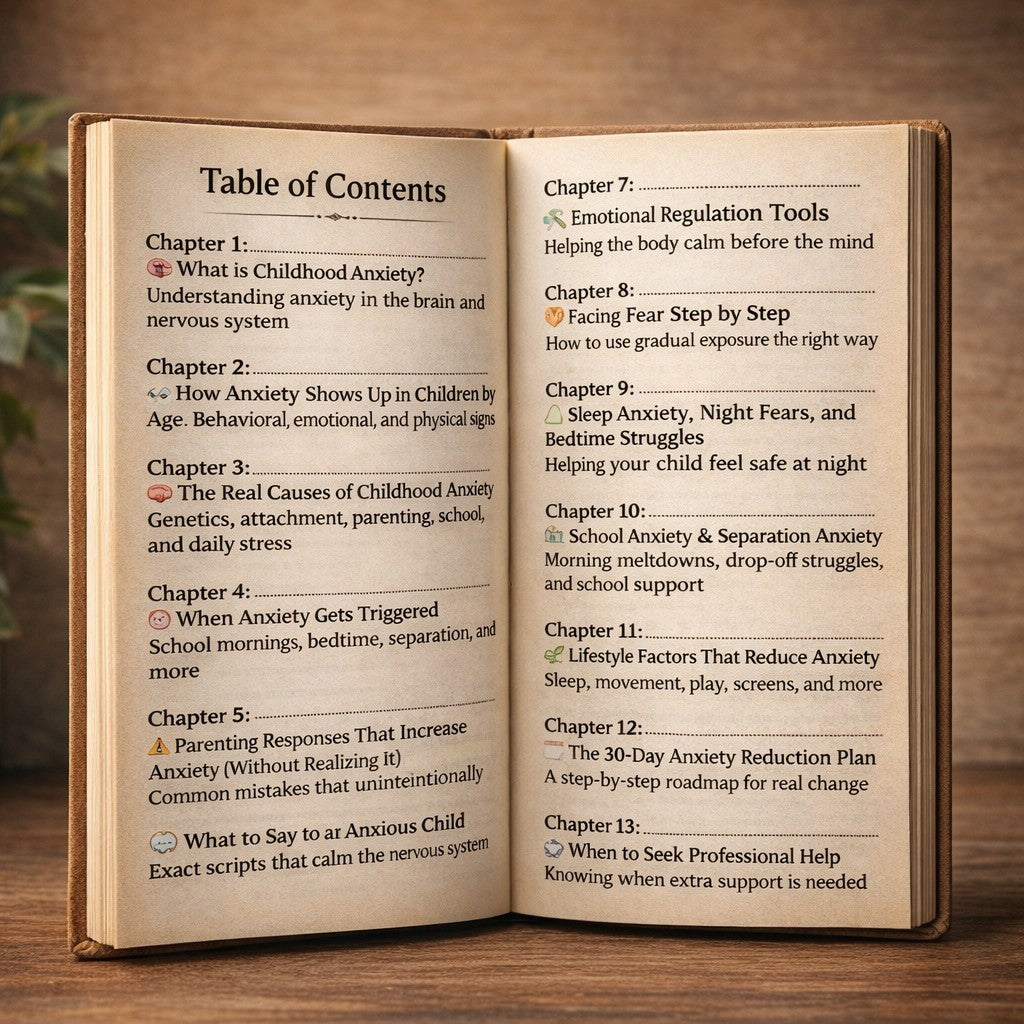
• Understand how anxiety works in the child’s brain and nervous system
• Recognize the real emotional, behavioral, and physical signs of anxiety
• Identify the hidden causes of childhood anxiety, including school stress, overprotection, and environmental factors
• Avoid common parenting responses that unintentionally make anxiety stronger
• Use calm, supportive language that helps children regulate their emotions
• Teach children simple emotional regulation tools such as breathing, grounding, and body awareness
• Help your child face fears gradually using evidence-based exposure techniques
• Support children struggling with school anxiety, separation anxiety, and bedtime fears
• Build healthy routines that strengthen the nervous system and reduce anxiety naturally
The book also includes a 30-Day Anxiety Reduction Plan that helps parents apply these strategies step-by-step in real life.
anixious calm child.pdf
Designed for Real Parents and Real Life
Parents do not need hours of free time or advanced psychology knowledge.
The strategies in this guide are designed to fit into everyday family routines.
Most techniques take just a few minutes and can be used during common situations such as:
• School mornings
• Bedtime struggles
• Emotional meltdowns
• Social anxiety
• Homework stress
Small, consistent changes can create powerful improvements in how children respond to stress.
Who This Book Is For
This guide is especially helpful for parents of children who:
• Worry constantly
• Cry easily or feel overwhelmed
• Refuse school or social activities
• Struggle with separation anxiety
• Experience bedtime fears or sleep anxiety
• Frequently complain of stomachaches or headaches related to stress
If your child often feels anxious, sensitive, or easily overwhelmed, this guide will help you understand what is happening — and how to respond with confidence.
A Compassionate, Science-Based Approach
This book does not blame parents and does not label children.
Instead, it offers a clear and hopeful message:
Anxious children are not broken.
Their nervous system has simply learned to stay on high alert — and it can learn to feel safe again.
With the right support, children can learn how to calm their bodies, face fears gradually, and develop real emotional resilience.
This guide shows parents how to help that process begin.
terms of use
terms of use
This ebook is a digital product for personal use only.
By purchasing this product, you agree that you may:
Download and use the ebook for personal or family use
Print pages for your own child
You may not:
Share, resell, redistribute, or reproduce this ebook
Upload or share it online or with others
Use it for commercial, classroom, or therapeutic purposes
Modify or claim the content as your own
This ebook is for educational purposes only and does not replace professional medical or mental health advice.
Refund Policy
Due to the digital nature of this product, all sales are final.
Refunds may be considered only if:
The file cannot be downloaded or opened
There is a technical issue with the ebook
The product received is not as described
Please contact us within 7 days of purchase if you experience any of these issues.
Couldn't load pickup availability
30-Day Money Back Guarantee


Sizing Chart
| Size | Bust (cm/in) | Length (cm/in) | Sleeve (cm/in) | Waist (cm/in) | Hip (cm/in) | Length (cm/in) |
|---|---|---|---|---|---|---|
| S | 106 / 41.7 | 73 / 28.7 | 24.5 / 9.6 | 72 / 28.3 | 108 / 42.5 | 49 / 19.3 |
| M | 112 / 44.1 | 75 / 29.5 | 25 / 9.8 | 78 / 30.7 | 112 / 44.1 | 50 / 19.7 |
| L | 118 / 46.5 | 77 / 30.3 | 25.5 / 10.0 | 84 / 33.0 | 118 / 46.5 | 51 / 20.1 |
| XL | 124 / 48.8 | 79 / 31.1 | 26 / 10.2 | 90 / 35.4 | 124 / 48.8 | 52 / 20.5 |
| XXL | 130 / 51.2 | 81 / 31.9 | 26.5 / 10.4 | 96 / 37.8 | 130 / 51.2 |
53 / 20.9 |
Give your customers further information about choosing the correct size.
The Calm Child Method™
Your child isn’t being difficult. Their nervous system is asking for help.
You’ve reassured them more times than you can count. You’ve stayed until they fall asleep. You’ve negotiated, comforted, and rearranged your mornings around their fear. And still — the stomachaches before school. The crying at drop-off. The bedtime that never ends.
What most parenting advice misses is this: anxiety isn’t a behavior problem. It’s a nervous system problem.
When you understand what’s actually happening in your child’s brain — the amygdala, cortisol, the fight-or-flight response — everything you do as a parent starts to make more sense. And more impact.
This guide was built to give you that understanding. And then to turn it into something you can use — today.
WHAT THIS GUIDE DOES FOR YOUR FAMILY
Calming Anxiety in the Moment
Learn why logic fails during an anxiety episode — and what to do with your child's body and nervous system before any words can help.
Peaceful Nights & Better Sleep
A science-based bedtime routine plus a gentle, step-by-step plan for building independent sleep — without the same exhausting battle every night.
School Confidence & Easier Drop-Off
Understand why school mornings trigger the nervous system — and apply strategies that make drop-off progressively shorter and calmer.
Emotional Regulation Skills That Last
Breathing, grounding, movement, and touch — tools your child can use in anxious moments now, and carry with them for life.
Fewer Meltdowns & Emotional Storms
When you understand the triggers, you can intervene early — before the storm hits. The guide maps your child's specific patterns.
Knowing Exactly How to Respond
Word-for-word scripts for every hard moment: reassurance loops, school refusal, bedtime fear, separation. Stop guessing — respond with clarity.
13 chapters. Every answer you’ve been looking for.
Understand the amygdala, fight-or-flight, and why your child literally cannot “just calm down” on their own.
Brain ScienceRecognize anxiety in behavior, emotions, and physical symptoms — including the stomachaches that aren’t imaginary.
RecognitionGenetics, attachment, overprotection, screens, small traumas — a judgment-free explanation that ends the guilt spiral.
Root CausesMap your child’s personal anxiety landscape: school mornings, bedtime, homework, social events, and life changes.
TriggersThe 6 loving parenting habits that accidentally keep anxiety alive — and what to replace them with, starting today.
Common MistakesExact, situation-by-situation language for school mornings, bedtime, separation, and reassurance loops.
ScriptsBelly breathing, 5-4-3-2-1 grounding, movement release. Why body regulation must come before any conversation.
ToolsBuild a personalized fear ladder. The evidence-based approach used by therapists worldwide — now usable at home.
Fear LadderWhy anxiety gets louder at night — and a complete plan to gently build independent sleep step by step.
SleepMorning meltdowns, drop-off tears, school refusal — strategies that reduce avoidance and build real confidence.
SchoolHow sleep, movement, screens, nutrition, and routines either feed anxiety or quietly calm the nervous system daily.
LifestyleA week-by-week roadmap that turns everything in this guide into a structured, manageable daily practice.
30-Day PlanKnow with clarity when home strategies are enough — and when to reach for professional support. No fear, no guilt.
Professional HelpGrounded in science. Written for real life.
Most parenting resources stop at “validate your child’s feelings.” This guide starts there — and goes all the way to rebuilding your child’s nervous system confidence.
Polyvagal Theory, Attachment Theory, CBT, and trauma-informed care — translated into plain language for parents who want to understand, not just follow instructions.
Every principle is paired with exact language. You’ll know what to say during a school meltdown, a midnight fear, and a reassurance loop.
No forcing. No overwhelming. The fear ladder method is the most evidence-based approach to childhood anxiety — made usable at home.
Understanding isn’t enough. Change requires consistent action. The plan turns all of this into a realistic daily practice built for real parents.
Written for parents exactly like you
You’ve validated feelings, set limits, stayed calm (mostly). You’ve read the articles. This guide starts where the general advice leaves off.
Drop-off tears, Monday meltdowns, weekend stomachaches. Chapter 10 alone is worth more than most dedicated books on school anxiety.
The requests, the fears, the “one more minute.” Night anxiety exhausts families. An entire chapter is dedicated to rebuilding peaceful evenings.
You believe that truly understanding your child’s nervous system would make you a better support. You’re right — and that’s exactly what this provides.
Everything you need to genuinely help your child
Understand what’s happening in your child’s brain during anxiety — no more guessing
Recognize anxiety in physical symptoms like stomachaches that doctors dismiss as “nothing wrong”
Use word-for-word scripts in every anxious situation without having to improvise
Break the reassurance dependency loop without making your child feel abandoned
Build a personalized fear ladder for your child’s specific anxieties
Teach belly breathing, grounding, and movement tools your child will actually use
Create a bedtime routine that works with the nervous system — not against it
Make school drop-off progressively calmer over a matter of weeks
Understand how screen time and sleep habits amplify or reduce anxiety daily
Apply the 30-day plan to your specific child’s age and patterns
Know exactly when professional help is needed — and how to choose the right support
Respond to anxiety with patience instead of frustration — for both of you
Before this guide. After this guide.
Most families see meaningful shifts within 2–4 weeks of consistent application.
| × Before | ✓ After |
|---|---|
|
Every school morning is a negotiation that drains everyone
|
You understand what’s happening — and respond with genuine calm
|
|
Saying “you’ll be fine” — and watching it not work, again
|
You have exact words for every anxious moment — and they land
|
|
Staying until they fall asleep, every single night
|
Your child is gradually sleeping more independently, step by step
|
|
Guilt: “Am I making this worse somehow?”
|
You’ve replaced guilt with understanding — supporting, not fixing
|
|
Freezing during meltdowns — not knowing what to say
|
Meltdowns are shorter because you intervene earlier and more skillfully
|
|
The reassurance loop gets longer and more exhausting each week
|
Your child is building real courage — and they feel you believe in them
|
A complete parenting toolkit for anxious children
Compare this to a single child psychology session ($150–$250) or a parenting course ($97–$297). The Calm Child Method™ delivers more actionable, parent-focused content — for a fraction of the cost.
Neuroscience, tools, scripts, exposure method, sleep plan, school plan, lifestyle guide, and 30-day roadmap. Everything in one structured system.
Printable quick-reference for anxious moments — organized by situation, designed for the fridge.
Fillable, printable template to build and track a personalized exposure plan with your child.
Guided breathing, grounding, and connection in seven minutes — ready to use tonight.
Phone, tablet, desktop. No special app required. Delivered instantly after purchase.
Everything you need to know before getting started
Will this actually work for my child?
My child’s anxiety feels really severe. Is this still for us?
How quickly can I start applying this?
My child is only 3 or 4. Is this age-appropriate?
We’re already working with a therapist. Will this conflict?
What’s your refund policy?
We’re Not the Same
The Anxiety Guide is designed to give parents practical, science-based tools they can use immediately — without overwhelm, long waiting lists, or guesswork.
| Anxiety Guide | Therapists & Others | |
|---|---|---|
| Promotes Emotional Wellness | ✓ | ✓ |
| Provides Proven, Action-Based Strategies | ✓ | ✓ |
| Creates Lasting Behavior Change | ✓ | ✓ |
| Affordable & Accessible | ✓ | ✕ |
| Easy-to-Use, Anytime Tools | ✓ | ✕ |
| Designed for Parents, Teachers & Therapists | ✓ | ✕ |
We’re in a Whole Different Emotional League
Not all emotional resources for kids are created equal.
Many online downloads are generic and ineffective.EmotionSmartFamily offers expert-designed tools created specifically to support anxious children. Our worksheets and activities help kids understand worries, manage anxiety, and build emotional resilience using practical, evidence-based strategies.
Trusted by parents, educators, and child specialists.